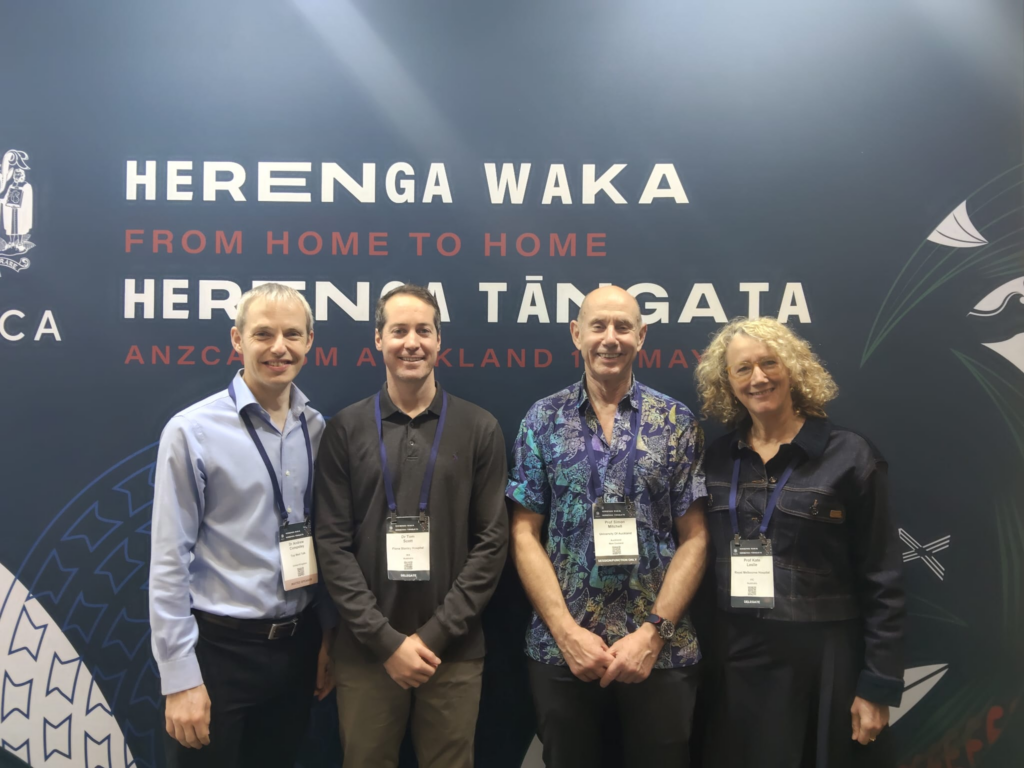
At ANZCA and the Faculty of Pain Medicine’s Annual Scientific Meeting 2026 in Auckland, TopMedTalk hosts Kate Leslie and Andy Cumpstey interview anesthetists and diving medicine researchers Simon Mitchell (Head of the Department of Anaesthesiology at the University of Auckland, Anaesthesiologist at Auckland City Hospital) and Tom Scott (aeromedical doctor with the Royal Flying Doctor Service Western Operations, based out of Perth, Western Australia) about studying extreme physiology in free diving and technical diving.
Scott and Mitchell describe expeditions measuring arterial blood gases in elite free divers (including world-record-level depths), using an arterial line and a closed sampling system to collect samples at depth and on surfacing. They explain shallow water blackout as a rapid fall in PaO2 during ascent due to lung re-expansion and oxygen consumption, reporting examples such as PaO2 rising to 42 kPa at 60 m and falling to 8 kPa at the surface, and average post–80 m PaO2 of 4.6 kPa.
They discuss logistics, ethics, safety implications for divers, distinctions between hyperoxia risks for compressed-gas technical divers versus hypoxia for free divers, and the role of mentorship in building such research programs.